

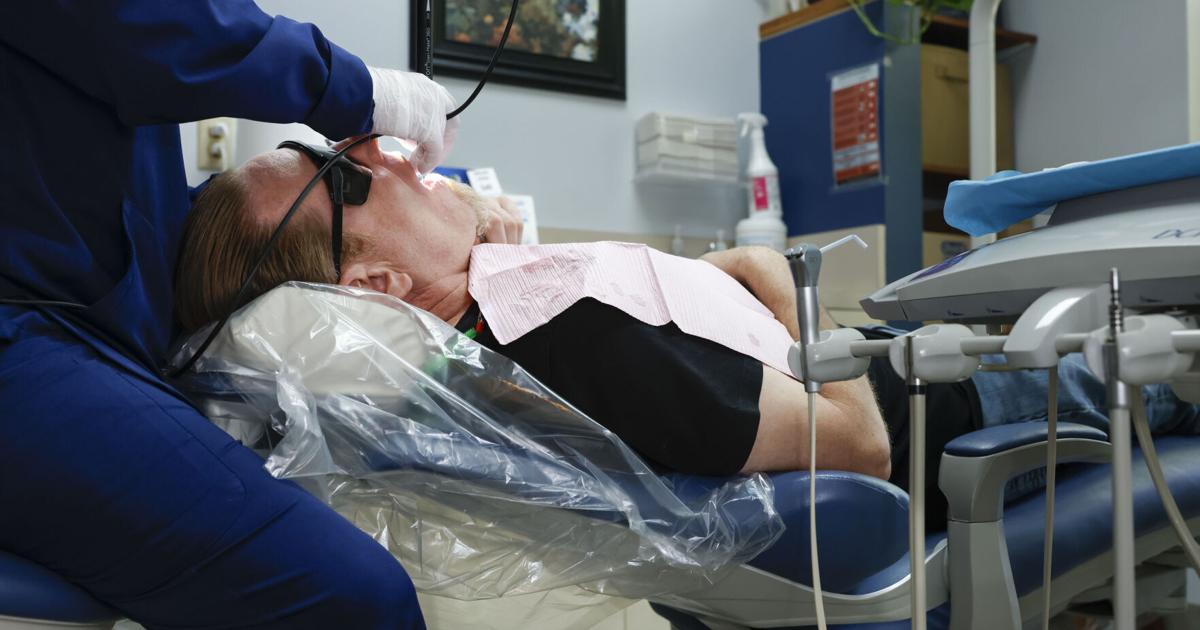
Last year, after 20 years of living with loose fillings and discomfort, Scott Moore started researching his options for finally fixing his teeth.
Moore earns too much as an auto repair technician to qualify for Medicaid, and he learned dental insurance likely wouldn’t pay much for the costly procedures he needed.
“I found out that pre-existing conditions weren’t covered, and it was going to cost me this much more on top of what I was paying for insurance, and the premiums were ridiculous,” Moore said. “When you have all these things that aren’t covered under dental insurance, which is where the big costs are, what’s the point of having it?”
Moore might have kept waiting if the pain hadn’t become unmanageable. His mom, a former social worker, told him about a north Madison nonprofit clinic called Affordable Dental Care, which specializes in providing care for uninsured and underinsured patients at prices up to 60% less than average. Founded in 2010 and relocated to Madison in 2018, it’s one of around 30 free and charitable clinics providing dental care in Wisconsin.
Those clinics are nowhere near enough to keep up with demand, even as Affordable Dental Care prepares to move to a larger building and double its capacity. At low-cost clinics and government-subsidized health care centers, new patients often wait months for care, if they can get in at all.
The challenge isn’t unique to Wisconsin. Over one-third of Americans have gone without any form of dental care in the last year, according to the Centers for Disease Control and Prevention.
The costs of going without care are stark. Poor oral health can increase the risk of cardiovascular disease, pneumonia and complications with pregnancy and birth. In a report by American Dental Association’s Health Policy Institute, 60% of Medicaid members without dental coverage said the appearance of their mouth or teeth limits their ability to apply for a job.
But while oral health affects overall health, health insurance generally excludes the mouth, leaving patients without separate dental insurance to bear the cost on their own. Even with dental insurance, restrictions and annual limits can leave patients on the hook for hundreds or thousands of dollars.
In some ways, Wisconsin has long been ahead of the game on dental access. While most state Medicaid programs historically covered dental care for children only, Wisconsin for more than 40 years has covered dental care for adults living in poverty.
In 2020, Wisconsin was one of just three states and the District of Columbia whose Medicaid programs offered “extensive” dental coverage for adults, according to a survey by the nonprofit CareQuest Institute for Oral Health. In the years since, five more states have joined that category, and 20 states have expanded benefits.
Medicaid covers one in seven Wisconsin adults, according to health think tank KFF, formerly known as the Kaiser Family Foundation. Still, most adults must have a household income at or below $15,060 a year to qualify, since Wisconsin is one of just 10 states that have not accepted federal money for Medicaid expansion. The estimated 75,000 undocumented immigrants living in Wisconsin don’t qualify for Medicaid, regardless of their income.
And qualifying for coverage doesn’t mean getting care. From 2021 to 2022, fewer than 10% of Wisconsinites on Medicaid received preventative dental care, according to an analysis by graduate students at University of Wisconsin-Madison’s La Follette School of Public Affairs. In nearly a third of counties, that rate was less than 1%.
In Dane County, of the nearly 97,000 people who were on Medicaid in 2021, less than one in three received dental care, and just three in 100 received preventative dental care.
Given Wisconsin’s trailblazing efforts, why are so many of its residents still not getting the dental care they need?

Wisconsin has fewer dentists than the national average, and about a third of its counties have no more than one dentist per 2,000 residents.
Low access, high stakes
For some Wisconsinites, geography alone can make it hard to get to the dentist. About a third of Wisconsin counties have no more than one dentist per 2,000 residents.
The share of Wisconsin dentists serving Medicaid patients is lower than the national average. In 21 counties, fewer than four out of every 10 dentists filed Medicaid claims in 2021 — and in seven counties, not one dentist did, according to the UW-Madison La Follette School analysis. The numbers were similar in Dane County, where about six out of 10 dentists filed no Medicaid claims that year and less than one-third of Medicaid patients received dental care.
The state would need nearly 200 full-time dentists to meet the needs of Wisconsin Medicaid members, the Department of Health Services estimated in 2019, declaring part or all of most Wisconsin counties dental care deserts for low-income residents.
Marquette University School of Dentistry professor Dr. Christopher Okunseri has spent much of his career researching health disparities. Demographically, he said, the people most likely to have poor oral health are the same people who tend to have poorer health in general: African Americans, Hispanic Americans, Native Americans and low-income people across the board.
But disparities are more extreme in oral health than in medicine, Okunseri said, because it can be harder to find a dentist. “In medicine, a lot of the physicians will take public insurance, Medicaid, but in dentistry, that’s not the case,” he said.
Okunseri credits Wisconsin for covering dental care for Medicaid patients long before many states did. For too long, Okunseri said, policymakers elsewhere have viewed dental care as “nonessential.”
That, he thinks, is all wrong. “You cannot have bad oral health and think you are well,” Okunseri said. “If the mouth is in trouble, I don’t see how the other parts of the body will remain intact.”
Those who can’t afford dental care often put off seeking help until the pain is too much to bear. Nearly 5,500 people visit U.S. emergency rooms each day for dental pain, according to the American Dental Association. But ER doctors aren’t well-equipped to care for dental problems, Okunseri said.
Okunseri believes the fact that more states now cover dental services for adults is a sign that policymakers are finally starting to understand that dental care is essential.

Marquette School of Dentistry professor Dr. Christopher Okunseri, who studies oral public health, says dental disparities tend to be more extreme than health disparities in general.
Medicaid patients still struggle to get care
To encourage more dentists to accept Medicaid, Wisconsin raised its reimbursement rate by 40% in 2021 and launched a campaign to train dentists on the process. Many dentists say that increase isn’t enough to cover their costs.
“The current rate still requires dentists to take a significant loss when treating patients. Many dentists will do that, but others simply can’t,” said Wisconsin Dental Association spokesperson Brenna Sadler. Apart from the money, some dentists balk at the paperwork and prior authorizations Medicaid requires, which “can make it difficult for them to provide the treatment they believe is appropriate and necessary,” Sadler said.
As a result, much of the responsibility for getting dental care to Wisconsin’s poorest residents has fallen to nonprofit organizations.
Access Community Health Centers offers dental care to patients with Medicaid, private insurance and no insurance at four clinics, including three in the Madison area. It also runs a mobile dental operation called Celebrate Smiles, which visits Madison schools to bring dental care to kids who otherwise might not see a dentist. As a federally qualified health care center, Access receives a higher Medicaid reimbursement rate than other providers get, designed to subsidize the care it provides to uninsured patients. In 2023, the organization saw more than 18,000 dental patients.
These days, when Access gets calls from prospective new patients, it prioritizes those with the most urgent needs. At its Madison clinics, most of those making the cut are pregnant people and children.
This summer, the nonprofit hired six new dentists. With staffing levels finally back to pre-pandemic levels, Access CEO Ken Loving said he wants to offer a “dental home” where more Madison-area residents could get routine care and cleanings, not just crisis care.
The goal, he said, is for patients to develop a relationship with their dental professionals so that they can keep improving their oral health together.
“We have opportunities to grow, and we know that the demand is there,” Loving said. “Our growth over the years has not been because we want to be this giant organization. It’s about people calling and wanting to say yes as often as we can.”
Meanwhile, the roughly 1.3 million Wisconsinites covered by Medicare must buy separate dental insurance plans or pay out of pocket, as the federal program for seniors and people with disabilities does not cover dental care unless it’s deemed necessary for treating another medical condition.
That group grew by 13% from 2018 to 2023, according to DHS, and it’s likely to balloon further as the average age in the state increases. According to a KFF survey, nearly half of Medicare members didn’t see a dentist in 2018, and the chances were even lower for Black, Latino and low-income members. About half of Medicare members had no dental insurance.
President Joe Biden sought to change that in 2021 with his $3.5 trillion Build Back Better package. His proposal to add dental coverage for all Medicare beneficiaries died with the bill.
Nonprofit offers an alternative
For uninsured and underinsured patients, the least expensive answer is usually to have problem teeth pulled, said Affordable Dental Care executive director Areli Estrada.
“Oftentimes people that do not have the financial means to cover their dental expenses … are going to go for the cheapest option, and then you end up not having teeth,” Estrada said.
Affordable Dental Care aims to give patients an alternative, so staff members explain the prices for each treatment approach and the grant money patients can apply for, Estrada said.
In Scott Moore’s case, Dr. Chelsea Kepler, the nonprofit’s clinical director and only full-time dentist, reviewed his X-rays, examined his mouth and broke the news.
“We have a lot of stuff to do,” Moore recalls her saying. “But we’re going to space it out and try and figure out what the plan of attack is going to be.”
The clinic said the treatment would cost around $7,000, but with a $3,000 scholarship from the nonprofit’s Agape fund, which subsidizes care for patients who can’t afford its reduced prices, Moore paid only $4,000.
That, he said, was far better than any other option he’d found. “I’m a very lucky person. I have a great job. I make really good money … but I have to make sacrifices to be able to take care of all my responsibilities, and the cost of insurance is just far too high.”

Chelsea Kepler is the clinical director and only full-time dentist at Affordable Dental Care. The clinic is preparing to move and double its capacity.
Affordable Dental Care growing fast
When Affordable Dental Care held a groundbreaking ceremony outside its future home in June, one of the people who stepped to the podium to praise the project was Madison Ald. Amani Latimer Burris.
“A clinic like this saved my smile,” Latimer Burris said, showcasing her grin. She didn’t know about low-cost dental clinics until 2009, when she got a toothache so intense that just going outside made her head pound. Her four front teeth, too, had loosened and started to shift. Though her husband was an attorney, the Great Recession had hit her family hard.
“I lived my middle class life and fell to the bottom and was begging for help,” Latimer-Burris said.
Fortunately for Latimer Burris, a crew of volunteer dental professionals was bringing Mission of Mercy, a massive, one-day, traveling free clinic, to Alliant Energy Center. There, she got emergency care and learned she’d need to seek other help if she didn’t want to lose her infected front teeth.
She visited one dentist after another looking for one she could afford. After calling Access nearly every day for a year, she finally got an appointment. It’s been a “10-year journey,” she said, but she credits Access with saving her teeth. She’s still a patient there today.
“Without clinics like this, there’s some of us that wouldn’t be able to be politicians and love their smile,” she told the crowd of Affordable Dental Care supporters. “We wouldn’t be able to serve others. We wouldn’t be able to advocate on a national level for change.”
Currently located at 2110 Fordem Ave., Affordable Dental Care has grown rapidly in recent years. In 2022, the clinic received a $759,000 grant from the Wisconsin Department of Administration, funded with federal pandemic relief money. The grant allowed the clinic to hire a second dentist, a hygienist, a community outreach coordinator and administrative assistant. With that help, Affordable Dental Care went from treating 14 patients a day to 24.
But demand has grown, too. While many clinics stop accepting new patients, Estrada said, “we do not turn anyone away.” New patients typically wait about four months for a comprehensive exam. Even patients with more pressing issues like a cracked tooth sometimes wait as long as six weeks.
“It’s a national issue: Demand for accessible dental care services will always be high no matter what,” Estrada said.
To cut wait times and serve more patients, the nonprofit is preparing to move to a larger clinic with eight exam rooms instead of four. The clinic plans to move to its new home at 1709 Aberg Ave. in November and begin offering around 5,000 appointments each year, nearly twice its current number.
“We no longer have the capacity to do more, so it’s in the best interest to expand and to double our impact,” Estrada said.
Meanwhile, Affordable Dental Care founder Tim Buck would like to see others start clinics based on the same model.
“I’ve been in the dental business for almost 45 years, and I know of nothing like this,” Buck said. “We could have 50 people doing the same thing and spreading this whole concept throughout the country, throughout the world.”

Speaking at the groundbreaking for Affordable Dental Care’s future clinic, Madison Ald. Amani Latimer Burris told the crowd that “a clinic like this saved my smile.”
Changes in the works
Fixing Wisconsin’s oral health disparities will require a variety of approaches, from licensing new types of professionals to offering alternative student loan repayment programs for students willing to work in underserved areas, argues Okunseri, the Marquette professor. The state should “throw everything you have” at the problem, he said.
“The whole issue of access to care in this country … is a complex issue, which means it requires complex solutions,” Okunseri said. “If we think simplistically, then we’re not addressing the issue.”
Some changes are already underway. The state’s campaign to recruit more dentists to Medicaid continues. Five new bills, signed into law in January, aim to boost Wisconsin’s dental workforce by, among other things, allowing the licensing of a new profession, dental therapists. Those therapists, whose work is somewhere between that of a dentist and a hygienist, earn about half as much as dentists. Proponents argued that adding those professionals to the field could ease ongoing shortages, especially for low-income patients, but it’s too soon to tell.
Legislators also included $20 million in the latest state budget to add or expand training programs for dental assistants and hygienists at Wisconsin technical colleges. With help from the Wisconsin Dental Association, Marquette recently secured scholarships for dental students who agree to work in the state’s dental deserts after graduation. In an effort to get and keep more dentists practicing in the state, Wisconsin has also sped up the licensing process for Marquette dental school graduates, allowing them to practice without taking a licensing exam. The Wisconsin Dental Association, which lobbies on behalf of the industry, said that as it develops its advocacy agenda for the coming budget season, increasing access to dental care is one of its “top priorities.”
Other changes are on the table. A new Biden administration rule will let states decide whether to add dental coverage to their Affordable Care Act plans, but Wisconsin has until the end of 2026 to decide. In May, U.S. Sen. Bernie Sanders introduced legislation that would give comprehensive dental coverage to all recipients of Medicare, Medicaid and veterans benefits, and increase funding for a variety of programs designed to improve oral health.
And in August, a task force appointed by the governor to bolster Wisconsin’s health care workforce recommended, among other things, the state expand Medicaid and consider creating additional pathways for foreign-trained health professionals to get licensed in Wisconsin, two policies that could increase access to dental care. Currently, dentists trained at almost all dental schools outside of the U.S. and Canada are eligible to practice in Wisconsin only as faculty members at the state’s one dental school — Marquette.
That’s Okunseri’s situation. Despite 20 years of teaching future Wisconsin dentists and treating low-income patients through the school’s clinics, he can’t see patients independently because the university where he trained in Nigeria isn’t accredited by the American Dental Association’s Commission on Dental Accreditation.

Affordable Dental Care executive director Areli Estrada, third from left, shovels dirt at a June groundbreaking event for the clinic’s new home at 1709 Aberg Ave. in Madison.
He applauds the state’s efforts to grow the profession’s ranks but notes his research shows diversifying the dental ranks may itself increase access.
“Minority dentists are more likely to serve minority patients, and the minority patients are more likely to seek out the minority dentists,” Okunseri said.
The private sector is also offering a new option. In July, the Wisconsin Dental Association launched its Dental Savings Club. For an annual fee of $48 for an individual or $108 for a family, Wisconsinites can get 15% to 55% off the median rates listed by the nonprofit FAIR Health, with most services covered. As of August, 275 dentists practicing at 400 locations had signed up and agreed to charge the same fees. The American Dental Association told the Cap Times that, while it doesn’t track every program offered by state and local dental associations, it didn’t know of any similar program elsewhere.
Meanwhile, local clinics will keep trying to meet the needs of those still struggling to find care they can afford. Back at Affordable Dental Care, Moore’s mouth overhaul took a year and at least a dozen appointments. After having multiple teeth pulled and crowns and fillings fixed, he received his partial dentures in August.
Two weeks later, he returned for a standard, preventative cleaning, paying $75 out of pocket. Already, the hygienist told him, his mouth looked healthier.
“It’s really changed a lot of things for me as far as how I look at myself,” Moore told the Cap Times. “I love looking in the mirror now and saying, ‘I can smile again.’”
He’s been urging his family and friends to visit Affordable Dental Care too. “This is something that we all need,” Moore said. “Every person needs to have a doctor to look at them. Every person needs to have a dentist to check out their teeth, so the cost of it shouldn’t be as high as it is.”
In August, he scheduled an appointment for his wife to start treatment, too. The first available appointment was for December, four months away.
link