

Study design and inclusion criteria
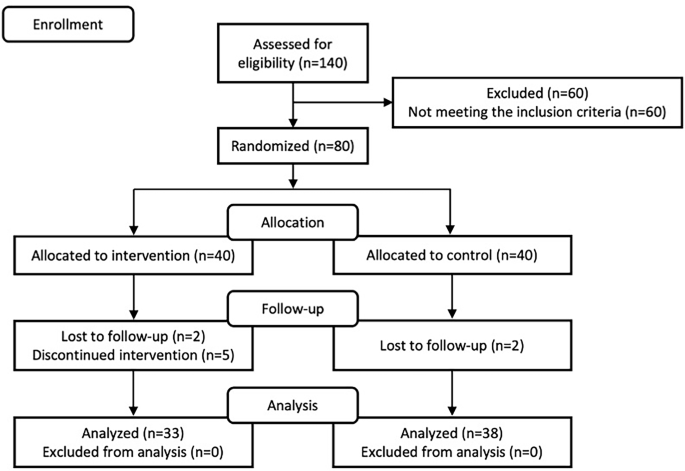
This study was a 1:1 allocation randomized controlled parallel trial. A computer-generated list from www.randomization.com was used to perform participant randomization. Data were inputted and randomized by a dental hygienist according to the saliva examination order. Similarly, a single-blind, oral examiner-blind design was adopted in this study. University students from non-medical fields between 18 and 25 years old were eligible subjects. Students who had DMF-T ≥ 7, had fixed orthodontic or prosthodontic appliances, were on antibiotics, or had used chlorhexidine mouthwash within two weeks before the recruiting date were excluded from participating. The subjects were recruited from The Faculty of Teacher Training and Education, Ahmad Dahlan University, Indonesia. All procedures adhered to the Declaration of Helsinki. This study was approved by the Ethics Committee Faculty of Dentistry, Universitas Gadjah Mada (217/UNI/KEP/FKG-RSGM/EC/2022) and registered in the Thai Clinical Trial Registry (TCTR20230105003), which can be accessed at Participants provided written informed consent prior to enrollment. In addition, this study followed the CONSORT statement.
Data collection
All participants completed the preliminary screening questionnaire, and those who satisfied the inclusion criteria then underwent an oral examination to establish the status of the caries experience. Following that, those with DMF-T < 7 underwent salivary examinations, including caries activity test, saliva hemoglobin level, and total bacterial count. They were also asked to complete several questionnaires, including a questionnaire on oral health knowledge (OHK) and the oral hygiene behavior index (OHBI) [8, 19]. The DMFT scoring was performed by calibrated examiners. The intraclass correlation coefficient was 0.75, indicating good agreement between examiners. Caries activity test and salivary hemoglobin level were rated by two examiners who reached consensus based on visual color interpretation, while total bacterial counts were determined by the device automatically.
Intervention
Maintaining good oral hygiene behavior involves several key points, such as brushing two times a day (after breakfast and before bedtime) using a soft-bristled toothbrush and fluoride toothpaste with minimal pressure for two minutes, and practicing daily interdental cleaning and tongue cleaning to remove plaque and bacteria [19]. To reinforce these, an oral health intervention was designed in a 21-day video-based program via web platforms. The video was intentionally designed to last for three minutes. Toothbrushing alone is generally recommended for 2 min, with additional time allocated for interdental and tongue cleaning. By coordinating the duration of the video with the task, the intervention aimed at strengthening behavior and enabling students to incorporate learning materials into their daily lives. While the video was intended to be watched during toothbrushing, participants were also able to view it at other times. Furthermore, the intervention was conducted for 21 days, which aligned with the previous studies [15, 20]. The educational material has been adopted and modified to the OHK and OHBI, which were developed based on the TPB construct. Several BCTs, such as providing information on consequences and giving oral hygiene instructions, were also implemented in the intervention [8, 19]. During the first week, videos about the oral cavity and oral health problems were introduced as established foundational knowledge. In the second week, videos describing oral health problems related to nutrition and smoking and their impact on general health were then explained. In the last week, plaque management, comprising toothbrushing, interdental brushes, and tongue cleaning, was introduced as an essential strategy to maintain oral hygiene. A video was followed by a simple quiz to reinforce learning, and summary videos were presented on days 7, 14, and 21 to review the materials from the preceding week and enhance knowledge retention. The effectiveness of this educational intervention will be assessed through an OHK and OHBI questionnaire administered three months after its completion. Monitoring was conducted using the video completion tracking feature integrated into the web-based platform. Incomplete viewers were excluded to ensure data reliability. On the other hand, the control group received conventional dental health education. At the start of the study, all participants, including the control group, were given brief oral health instructions covering toothbrushing techniques, recommended duration, and frequency. These instructions were provided immediately after the dental examination to ensure ethical treatment of all participants. After randomization, the control group did not receive any intervention.
Outcomes
The outcome of the study was oral hygiene behavior change, which was assessed through the OHBI questionnaire. This questionnaire was developed based on the TPB [19]. This questionnaire explores several oral hygiene items, including toothbrushing frequency, toothbrushing moments, toothbrushing force, toothbrushing duration, toothbrushing method, fluoride toothpaste, interdental cleaning, and tongue cleaning. The OHBI score goes from 0 to 17, with a higher score suggesting good oral hygiene behavior. In addition, the OHK questionnaire comprises 11 true/false questions, with a higher score indicating better OHK. The OHBI and OHK questionnaires showed high internal consistency (α = 0.65 and α = 0.74, respectively) and correlated significantly with TPB constructs [8]. The Indonesian version of OHBI showed good validity and reliability when implemented in adolescents [21]. To further evaluate its reliability in university students, we conducted a test-retest analysis. The results indicated that the OHBI questionnaires had good reliability (α = 0.87).
Oral health status, determined by the caries activity test, salivary hemoglobin level, and total bacterial count, was also assessed. These outcomes were objective measurements that served as complementary validation of the effect of behavior change. Food, drink, and oral hygiene were prohibited for all participants for at least two hours before the oral assessment. Saliva was collected around 10 and noon to reduce the impact of diurnal fluctuations on the components of saliva.
Caries activity test
Caries activity test was measured using the resazurin disc test (GC Showa, Japan) for evaluating the cariogenic bacterial activity. A 0.03 mL saliva sample from each participant was placed at the center of a disc of paper. The disc was then incubated at a temperature of 32–37 °C for 15 min to activate cariogenic bacteria. Instead of using an incubator, which requires a long time, the disc can be placed on the upper arm with the sleeve down to maintain optimal temperature [22]. Results were indicated by three color gradations, indicating the degree of caries activity from the interaction between bacteria and saliva. Maki et al. [23] demonstrated that resazurin discs were highly sensitive to gram-positive microorganisms such as S. mutans, S.mitis, S. faecalis, S. aureus, L. casei, and B. subtilis. The test’s sensitivity also correlated with the number of S. mutans and Lactobacilli present in saliva. While this test is commonly used in Japan to monitor oral hygiene, evidence is limited, and recent research has reported an association between elevated resazurin scores with poorer oral health status was based on very small samples [24].
Salivary hemoglobin level
Salivary hemoglobin levels were measured using Perioscreen (Sunstar, Osaka, Japan). Approximately 1 mL of saliva was collected and diluted five times with water to prepare the sample for measurement. The Perioscreen strip is then immersed in the saliva sample. After 5 min, the color change in the strip was compared with the manufacturer’s to estimate the hemoglobin level, which was categorized into 0, 2, and 5 μg/mL. Previous studies confirmed its high sensitivity in correlating with the percentage of BOP and pocket depth <4 mm [25]. Compared to the salivary multi-test, Perioscreen showed more sensitivity in assessing periodontal conditions. Additionally, it can be used to guide, assess, and motivate patients [26].
Total bacterial count
A dorsum tongue swab was collected and analyzed with a fast bacterial quantification technique (Panasonic Healthcare Co. Ltd., Tokyo, Japan). The bacteria were quantified using a dielectrophoretic impedance measuring (DEPIM) system. Total bacterial counts measured utilizing DEPIM correlated with standard plate counting and mixed bacterial suspension [27, 28]. Furthermore, total bacterial count was found to be associated with oral hygiene, with a higher bacterial count indicating poor oral hygiene [29]. In our study, the bacterial count was used solely to quantify changes in total bacterial load before and after intervention.
Sample size
A pilot study involving 27 students was carried out before this study. An effect size of 0.74 resulting from the pilot study was used to estimate the sample size. The calculation was carried out using the most recent G*Power (version 3.1.9.6) on a two-tailed t-test [30, 31]. The minimum sample size of 31 participants for each group was necessary, with a power level of 0.80 and a significant difference threshold of 0.05. The number of participants in each group was increased to 40 to allow for potential loss to follow-up throughout 3 months.
Statistical analysis
The data was analyzed utilizing STATA version 19. Normality of continuous variables was assessed using the Shapiro–Wilk test. Baseline differences between intervention and control groups were evaluated using independent t-tests or Mann–Whitney U tests for continuous variables, and chi-square or Fisher’s exact tests for categorical variables. To examine attrition bias, completers and dropouts were compared at baseline using the same approach. Within-group changes from baseline to follow-up were analyzed using paired t-tests or Wilcoxon signed-rank tests for continuous variables, and the marginal homogeneity test for categorical variables. Statistical significance was set at p < 0.05, and effect size for the OHBI was estimated using Cohen’s d.
link