


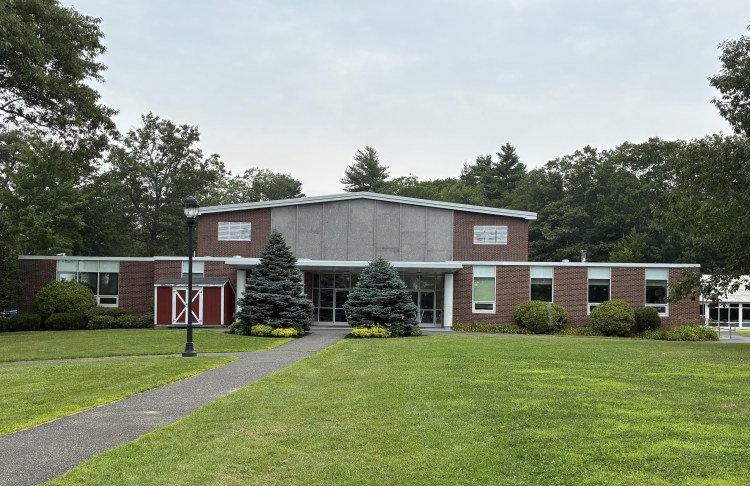
Pineland Farms’ Outdoor and Fitness Center, which New Gloucester is considering reopening. (Rory Sweeting/Staff Writer)
New Gloucester officials debated whether to accept a donation of about $200,000 from Planson International to reopen Pineland Farms’ Outdoor and Fitness Center for town use at a recent Select Board meeting.
According to a document attached to the meeting agenda, the Pineland fitness center was renovated in 2001 by the Libra Foundation, which owns the Pineland Farms property. It was used by the YMCA of Southern Maine until 2022, and was operated by Pineland as the Pineland Outdoor and Fitness Center until June of this year, when it was closed due to high operating expenses and limited revenues. With the donation from Pineland, the town of New Gloucester is considering whether to accept the money and operate the building on a two-year lease.
At the July 21 Select Board meeting, Town Manager Bill Kerbin asked Select Board Chair Colleen Strickler about the building’s previous uses and tenants, citing a Facebook post from Pineland that said the building is past its useful life, and the infrastructure is no longer feasible to maintain. Kerbin said an inspection was done by New Gloucester’s code enforcement officer, which found the building was for the most part in good shape, but that the HVAC system was at the end of its life.
Strickler said she had received several emails and phone calls, with one of them asking whether it would be possible to have volunteers staffing the front desk. Parks and Recreation Director Sarah Rodriguez said she hoped that volunteers would be a solution the town could look into as a way of reducing the costs of staffing the desk. She said someone covering even a couple of hours a day would help with the costs associated with the position, which board member Peter Bragdon said would cost the town $68,000 a year.
Rodriguez proposed a workshop with the Parks and Recreation Committee and the Select Board to sort out some of the details, vet some ideas, and “get their marching orders down in a solid way” so the town could make a solid decision on where it needs to get to before entertaining the idea of a lease, or deciding what its use of the facility would look like beyond the initial two-year lease.
Board member Rachel Lyn Rumson said she saw the current state of revenue from existing programs, but needs to know what the town’s projections are before it brings the issue to voters. Rumson also said she has heard conflicting reports from locals, with some saying that it was a bad look, and others saying that it was a genius idea.
“It’s a really polarizing issue, and I wish it wasn’t,” said Rumson. “I wish it was just a practical move through the policy decision and (we can) make good choices together.”
Strickler said she was leaning in favor of accepting the purchase, but that, if the town stops using the building after the initial lease, it sets up an expectation of services that the town would be taking away. Rumson also asked whether the capacity would increase over the initial lease period. Rodriguez responded that it would have a lot more room for youth activities such as summer camp and junior basketball programs, and Gray-New Gloucester Recreation was discussing whether leaders in training would be relocated from the Gray rec campus.
Rodriguez said she and Kerbin had met with the Libra Foundation, and she thinks it is waiting for the town to take the first step of accepting the gift, but that it was happy with the proposed uses. However, Libra is not willing to take on the liability of the HVAC failing, and if the system fails, the town will have to renegotiate with the foundation.
Regarding connecting the facility to the internet, Rodriguez told the board that she contacted GoNetSpeed, which has an office at the Pineland campus, about installing fiber internet at the facility. GoNetSpeed, she said, would waive the costs of installation and provide internet services at the cost of $170 per month.
Board member Stephen J. Hathorne said that his biggest hurdle was the HVAC system, and wanted to see how the town can make it a binding contract with Planson in regards to maintenance.
Bragdon also expressed concerns about the fact that the owner of the building was backing out of maintenance because of the condition of the building, and said that he was worried that the town was putting itself in a precarious position, wanting firm numbers on what repairing the building would to cost the taxpayers. When Bragdon brought up the former pool area, which reportedly had a leaky roof and could potentially lead to mold issues, Rodriguez said that the section would not be part of the rec department’s plans, and a potential long-term solution could be to demolish that part of the building, which would cost $15,000.
The meeting ended with no action taken on the part of the Select Board. Bragdon said that he hoped the Parks and Recreation Committee would meet ahead of the workshop to figure out the exact costs of maintaining and repairing the building.
link