


Source
Owners of small businesses are, on average, a strongly right-leaning group. Indeed, along with white Christian nationalists, they are one of the core components of the MAGA base. And small business owners celebrated Donald Trump’s victory last fall. Small business optimism, as measured by the National Federation of Independent Businesses’ monthly survey, soared after the election:


Source
Yet 2025 was a miserable year for small business — and 2026 will be worse.
Before I get into the reasons MAGA is so bad for some of its most fervent supporters, let’s talk about why small-business owners lean right.
Partly it’s a matter of who they are. Other things equal, higher income — which means paying more in taxes and being less likely to depend on the safety net — tends to make a voter more Republican. However, higher levels of education, which are correlated with income, tend to make voters more Democratic.
This is a fairly new development — as recently as two decades ago the correlation between education and partisanship went the other way. I would attribute this reversal to the changing nature of the G.O.P., which has become ever more anti-intellectual and anti-science. For the purposes of today’s post, however, this doesn’t matter. The point, instead, is that if we ask who in America is likely to have relatively high income either without having a college degree or without having had any postgraduate education — and therefore be predisposed to favor Republicans — the answer is clearly owners of successful small businesses.
Beyond that selection effect, a recent study of small-business partisanship by Malhotra, Margalit and Shi finds that “the experience of being a small business owner leads people to adopt conservative views on government regulation.” So small business owners supported Trump in the belief that he would get the government off their backs.
That’s not what happened. Instead, the second Trump administration has been marked by increased government-imposed burdens on small business. High tariffs have been a body blow to the many small businesses that rely, one way or another, on imported goods. Mass arrests of immigrants have also been highly disruptive for businesses, such as construction contractors, that depend on foreign-born workers.
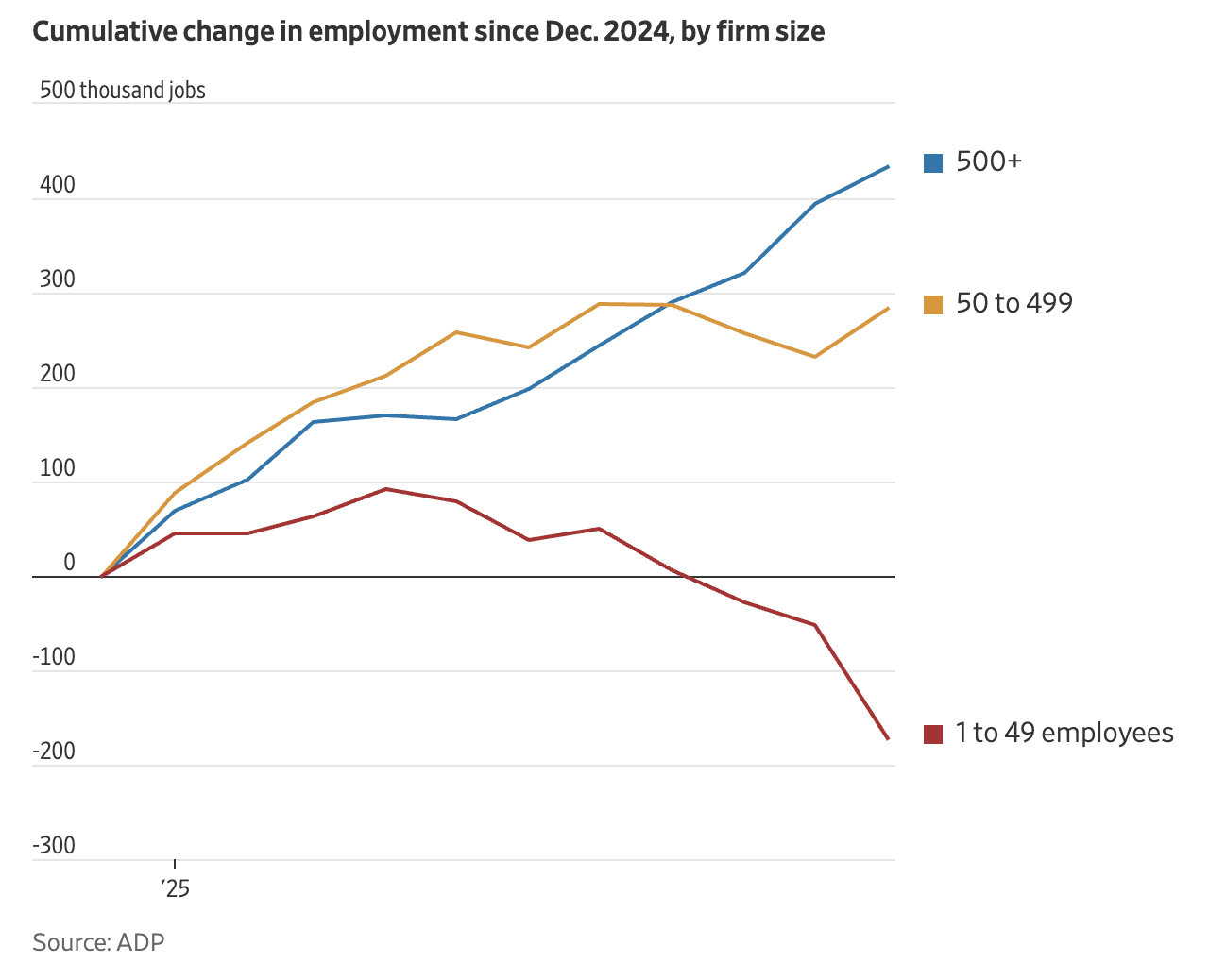
You might be tempted to say that these are burdens on all businesses, not just small business, which is true. But large businesses have been better able to weather the Trump shock than small businesses, for at least three reasons.
First, big businesses are more likely than small businesses to have the resources needed to adapt to a suddenly changed business environment. Suppose, for example, that a business has been heavily reliant on inputs imported from China, which now face an average tariff rate of 37 percent. A large corporation can try to find alternative suppliers in nations that face much lower average tariffs, such as Vietnam and Mexico. A small business won’t have the staff or money to search for and develop these alternative sources of supply.
Second, big businesses are better able to game the system. For example, one unanticipated result of the Trump tariffs has been much more thorough exploitation of the rules of the U.S.-Mexico-Canada trade agreement, the agreement formerly known as NAFTA. It turns out that until this past spring, there were many goods produced in Mexico and Canada that were legally entitled to enter the U.S. duty free — but as long as tariffs were low, many importers chose not to pay the legal fees or fill out the paperwork needed to claim these exemptions. When Trump went on his tariff spree, the incentives changed, and many companies decided that the cost of the extra paperwork was worth it, after all:


Source
But big corporations were much better positioned than small businesses to bear the cost of certifying that the goods they import are “USMCA-compliant.”
Finally, under Trump the United States has moved rapidly toward crony capitalism, a situation in which businesses with strong political connections get favorable treatment. Under this system, big businesses can in effect buy themselves a privileged position. Small businesses can’t.
For example, Apple has so far dodged most of the negative impact of Trump’s tariffs. Over the summer Trump imposed punitive tariffs on India, which is where most iPhones sold in the United States are produced. But for some reason smartphones were exempted from Trump’s India tariffs. What’s the logic behind this exemption? Might it have something to do with the fact that Apple is helping to pay for the construction of the grotesque ballroom that Trump is building to replace the demolished East Wing of the White House?
All of these factors help explain the trends shown in the chart at the top of this post: 2025 was a difficult year for many businesses not benefiting from the AI boom, but it was especially hard on small business.
But the worst is yet to come — or, actually, is happening as you read this.
Small-business owners tend to be disdainful of government, yet in many cases they and their employees depend in crucial ways on government programs. In particular, almost half of the adults receiving health insurance via the government-run exchanges established by the Affordable Care Act — Obamacare — either own or work for small businesses.
However, the cost of buying insurance on these exchanges has more than doubled on average since a year ago, because Trump and his party have refused to extend enhanced subsidies enacted under the Biden administration. As a result, many small business owners are in the process of finding out that they can no longer afford health insurance for their employees — or, in many cases, themselves.
In short, small business placed its faith in Trump but has been betrayed. But then, that’s what has happened to everyone who trusted Trump, from farmers to blue-collar workers — everyone, that is, except for the tech billionaires who have bought their way into his inner circle.
MUSICAL CODA
Could be about crony capitalism, could be about Ep*****

link